

Rackspace Technology (RXT): The Managed Cloud Comeback Nobody Saw Coming
RXT just surged 70% in a day. The turnaround is real. The margin of safety is gone. Here is how to think about what comes next.

TL;DR
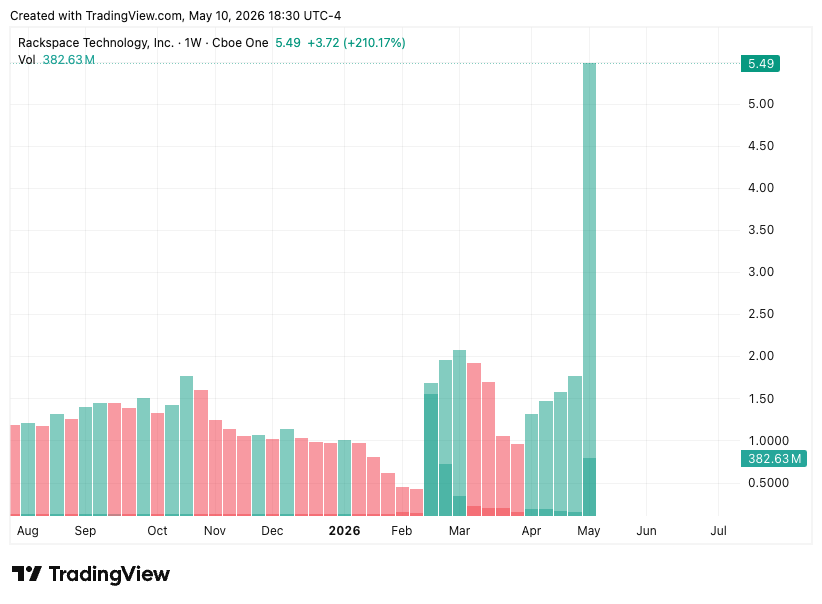
Rackspace Technology (Nasdaq: RXT) surged 74.89% on Thursday May 7 and continued its momentum with a 56% climb on Friday May 8, more than doubling in 48 hours on earnings and an AMD AI partnership announcement.
Q1 2026 revenue of $678.1M beat estimates by 2.6% and the company posted its first GAAP profit in years at $8.3M net income versus a $71.5M loss a year ago.
The AMD partnership to build governed enterprise AI infrastructure for regulated industries was the real sentiment driver though it remains a non binding MOU with no contracted revenue attached yet.
Private cloud is guided to grow for the first time in years and AMD plus Palantir position RXT as a credible operator for regulated enterprise AI workloads but EPS is still guided negative for the full year at -$0.15 to -$0.20.
The balance sheet remains the existential risk: $2.478 billion in principal debt against total assets of $2.8 billion, resulting in negative shareholder equity, and every published analyst price target was blown through before Friday’s close.
At $5.49, RXT trades at roughly 0.5x trailing sales versus 0.3x before the pop, still well below IT sector peers at 2x but no longer a neglected value play.
The cloud infrastructure buildout is entering its second act. Act one was simple: everything goes to AWS, Azure, or Google Cloud, and on-premises dies. Act two is messier and honestly far more interesting. Enterprise IT buyers are waking up to a set of uncomfortable realities. Data sovereignty regulations are tightening. AI workloads are infrastructure-hungry monsters. And regulated industries like healthcare, finance, and government simply cannot hand their core workloads to a shared public cloud and call it a day.
This is where managed private cloud stops being a legacy concept and starts looking like a genuine infrastructure layer play for the AI era. And it is exactly the angle that makes Rackspace worth a serious look right now, even if the balance sheet still gives conservative investors pause.
What Rackspace Actually Does?
Think of Rackspace Technology (Nasdaq: RXT) as the contractor who does not just design your building but also wires it, runs the plumbing, and stays on retainer when anything breaks. The hyperscalers are the raw real estate. AWS sells you the land and the concrete. Rackspace builds the building and manages it for you.
The company operates two segments. Public Cloud (roughly 65% of revenue) is their managed services layer on top of AWS, Azure, and Google Cloud. They are not competing with hyperscalers; they sit on top of them, charging for expertise and operations. Private Cloud (35%) is owned and operated data center infrastructure for enterprises that need dedicated, governed compute. Historically the drag segment, though that narrative is now changing. Deep partnerships with AWS, Microsoft, Google, VMware by Broadcom, Dell, AMD, and Palantir round out the ecosystem.
The Catalyst: One Thursday in May
Rackspace Technology (Nasdaq: RXT) experienced a historic rally following its Q1 earnings report. Shares skyrocketed as much as 74.89% on Thursday, May 7, hitting an intraday high of $3.87. The momentum continued into the following session, with the stock climbing another 56% on Friday, May 8. By the end of the 48-hour window, the stock had effectively doubled, closing the week at $5.49.
At the May 8 close, the stock had surged far beyond the average analyst price target of $1.93, catching much of the Street off guard.
Two things drove the move. First, the numbers actually came in ahead of what the street expected. Q1 2026 revenue was $678.1M, up 2% year over year, against analyst estimates of $660.83M. Public cloud revenue hit $443.4M, up 7%. Private cloud was $234.7M, down 6%. Net income flipped to a positive $8.3M from a loss of $71.5M a year earlier, though that improvement was materially aided by a $55.8M gain on debt extinguishment so read that headline carefully.
Non-GAAP Operating Profit rose 19.9% year over year to $30.7M and Adjusted EBITDA increased to $71.2M. Those are the cleaner operational numbers and they are moving in the right direction.
Second, and arguably bigger for sentiment, was the AMD announcement. Rackspace signed an MOU with AMD to integrate Instinct GPUs, EPYC CPUs, and ROCm into a fully managed, governed enterprise AI stack, creating a managed alternative to commodity GPU rental. The Palantir partnership also got a spotlight, with the first joint deal closing in 41 days and a customer use case reducing quoting time by 94%.
The AMD MOU is non-binding. That matters. A definitive agreement is expected near term but until it is signed it is a directional signal, not contracted revenue.
Financial Reality Check
The balance sheet is the big overhang and it deserves plain language. Total debt principal stood at $2.478 billion across multiple facilities. You have a company with more debt than total assets and negative equity of $1.2 billion. That is not a conservative investment. That is a leveraged turnaround bet. (Investing.com)
The saving grace is cash generation. Operating cash flow on a trailing twelve month basis was $144M. That gives Rackspace enough runway to service debt and fund capex without a near term liquidity crisis as long as revenue stays stable.
At $5.49, RXT trades at roughly 0.5x trailing sales versus 0.3x before the pop, still well below IT sector peers at 2x but no longer a neglected value play.(Yahoo Finance)
Competitors, Risks, and Sentiment
The hyperscalers are not sitting still. AWS Managed Services, Azure Arc, and Google Distributed Cloud are all pushing into the governed enterprise space. The difference is that Rackspace can be multi-cloud neutral in a way a hyperscaler fundamentally cannot. That neutrality is a real selling point for enterprises running complex, multi-vendor infrastructure.
On private cloud, HPE GreenLake and Dell APEX are fighting for the same regulated enterprise deals. Neither has Rackspace’s managed services depth or its partner ecosystem, but both carry healthier balance sheets.
The macro risks are real. If enterprise AI infrastructure spend slows or if the regulatory tailwinds driving private cloud soften, the thesis weakens fast. The debt burden makes RXT unusually sensitive to any operational stumble or refinancing pressure.
Wall Street analysts remain skeptical even after the stock’s explosive run. Several firms continue to focus on Rackspace’s debt burden, inconsistent profitability, and execution risks, with RBC Capital maintaining a Sector Perform rating. The stock has now surged far beyond most published analyst price targets.
Conclusion: Threading a Very Specific Needle
I want to be direct about what the bull case actually requires. It is not just that AI is a tailwind. It is that Rackspace Technology (Nasdaq: RXT) specifically captures a growing share of governed enterprise AI infrastructure spending, converts the AMD and Palantir partnerships into durable contract revenue, stabilizes private cloud churn, and does all of that while servicing $2.478 billion in principal debt. That is a lot to execute simultaneously.
The framework that makes RXT interesting at these levels is simple: if you believe regulated industries will increasingly build dedicated AI infrastructure rather than run inference workloads on shared hyperscaler compute, Rackspace is one of the few publicly traded companies positioned to operate that category end to end. The AMD MOU, if it converts to a signed agreement, is exactly the kind of differentiated infrastructure layer offering that could justify a meaningful rerating.
The stock nearly quadrupled off its 52 week low of $0.39 before last Thursday’s 74.89% surge and Friday’s continued rally. Position sizing has to account for that volatility. The beta is 2.23 for a reason. This is not a buy and forget holding. Watch debt reduction, private cloud bookings, and the AMD definitive agreement every quarter.
Disclaimer: The Nex Report is not a registered financial advisor, broker, or investment dealer. All content published is for informational and educational purposes only and should not be considered financial, investment, legal, or tax advice. Certain articles, reports, or content may be sponsored or compensated promotional material, and The Nex Report, its affiliates, writers, or contributors may hold positions in securities mentioned. Small-cap and micro-cap stocks are highly speculative and involve substantial risk, including the potential loss of your entire investment. Readers should always conduct their own independent due diligence and consult with a licensed financial professional before making any investment decisions. The Nex Report makes no representations or warranties regarding the accuracy, completeness, or timeliness of the information provided and assumes no liability for any financial losses resulting from the use of this content.